Showing up ready.
Help your child build a routine, arrive on time, and see training as a commitment you support together.
 Book an intro class ↗
A NOTE TO OUR PARENTS
A difficult class can feel like the end of the story. With understanding, encouragement, and a plan, it can become a new beginning.
Find your next step ↓See the scientific studies ↓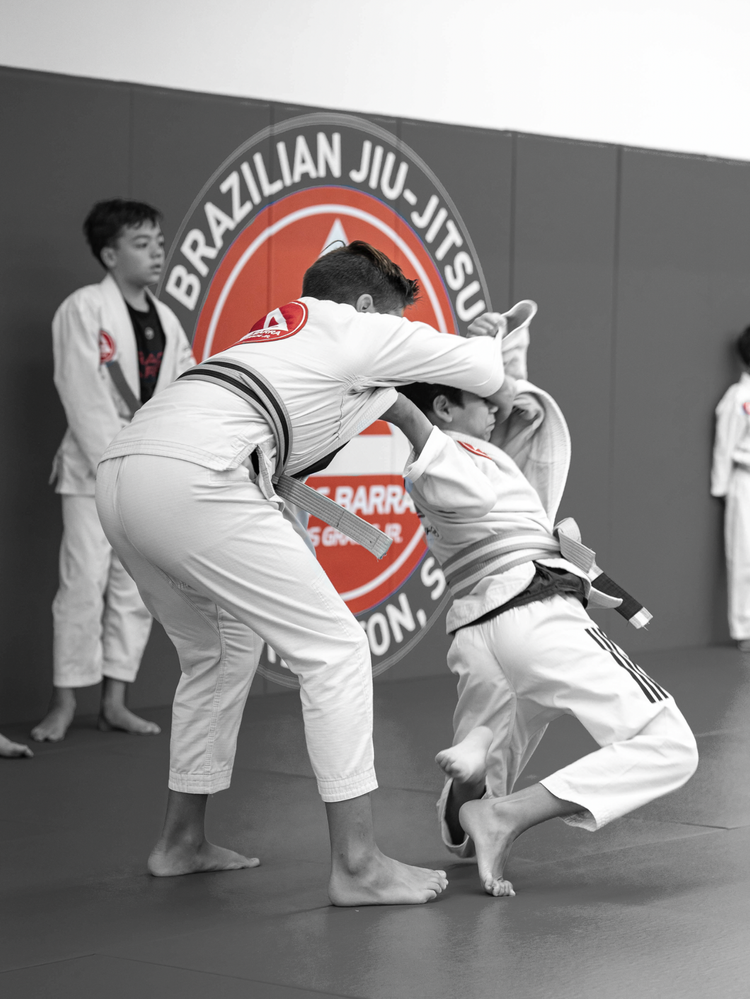
WHAT WE PRACTICE TOGETHER
Our goal is to help children learn how to meet a challenge, ask for help, and try again. That starts with a team around them.
BEFORE YOU DECIDE
“I want to quit” can mean many things. Start by finding out what your child is experiencing.
Talk with our team ↗Choose a calm moment and ask: “What felt hard today?” Was it a technique, a training partner, feeling tired, or not seeing progress? Listen before offering a solution.
Try asking: “What would make the next class feel better?”
Tell us what has changed. We can discuss class fit, training partners, and a manageable goal. If your child feels unsafe, hurt, or persistently unhappy, address that concern before asking them to push through.
A conversation gives us a starting point.
Choose a realistic routine together and a time to check in again. Focus on one achievable step: asking a question, practicing a technique, or arriving ready to join the class.
Recognize the effort. Revisit the plan together.
PROGRESS YOU CAN SEE
Stripes and belts recognize progress over time. Between promotions, there are smaller achievements worth noticing.
Help your child build a routine, arrive on time, and see training as a commitment you support together.
Praise a thoughtful attempt, a question asked, or a technique practiced again. Progress has many forms.
Notice when your child listens, supports a newer student, or helps a teammate learn. These moments count, too.
THE SCIENCE BEHIND THE PRACTICE
Three peer-reviewed studies offer evidence for self-regulation, sustained effort, and a supportive training environment. Here are their findings and the original sources.
SELF-REGULATION · 2004
207 children · 3-month intervention
Children assigned by classroom to school-based Tae Kwon Do showed greater improvements than a traditional PE comparison group in cognitive and emotional self-regulation, prosocial behavior, classroom conduct, and mental math performance.
This study examined Tae Kwon Do, not Brazilian Jiu-Jitsu. It supports the potential of structured martial arts training to develop self-regulation.
PERSEVERANCE · 2007
Multiple samples · Education, military & competition
Grit, defined as perseverance and passion for long-term goals, was associated with achievement across several settings. It explained an average of 4% of the variation in the success outcomes studied.
These findings support the value of sustained effort. They are not evidence that staying in any particular activity causes success.
STAYING ENGAGED · 2022
16 studies · 6,304 adolescent athletes
This systematic review found that motivation and sport experience had the strongest relationships with dropping out of team sports. The authors recommend environments that support motivation and enjoyment.
The review studied adolescent team sports. Its practical message for our school: pair consistency with encouragement, belonging, and an enjoyable experience.
These studies inform that approach. Each child’s experience still matters, and we work with families to find the right next step.
Watch Angela Duckworth’s talk on grit ↗YOU DON’T HAVE TO FIGURE IT OUT ALONE
Tell us how your child is feeling. We’ll make time to listen and help you decide on the next step.